A slider, spinner, and clicker can all be called fidget toys, but they create very different experiences. One moves back and forth, one rotates, and one responds with a press and click. There is no universally “best” fidget mechanism. The right choice depends on what your hands enjoy and where you plan to use it.
The quick comparison
| Type | Core motion | Sound profile | Fidget Bakery example |
|---|---|---|---|
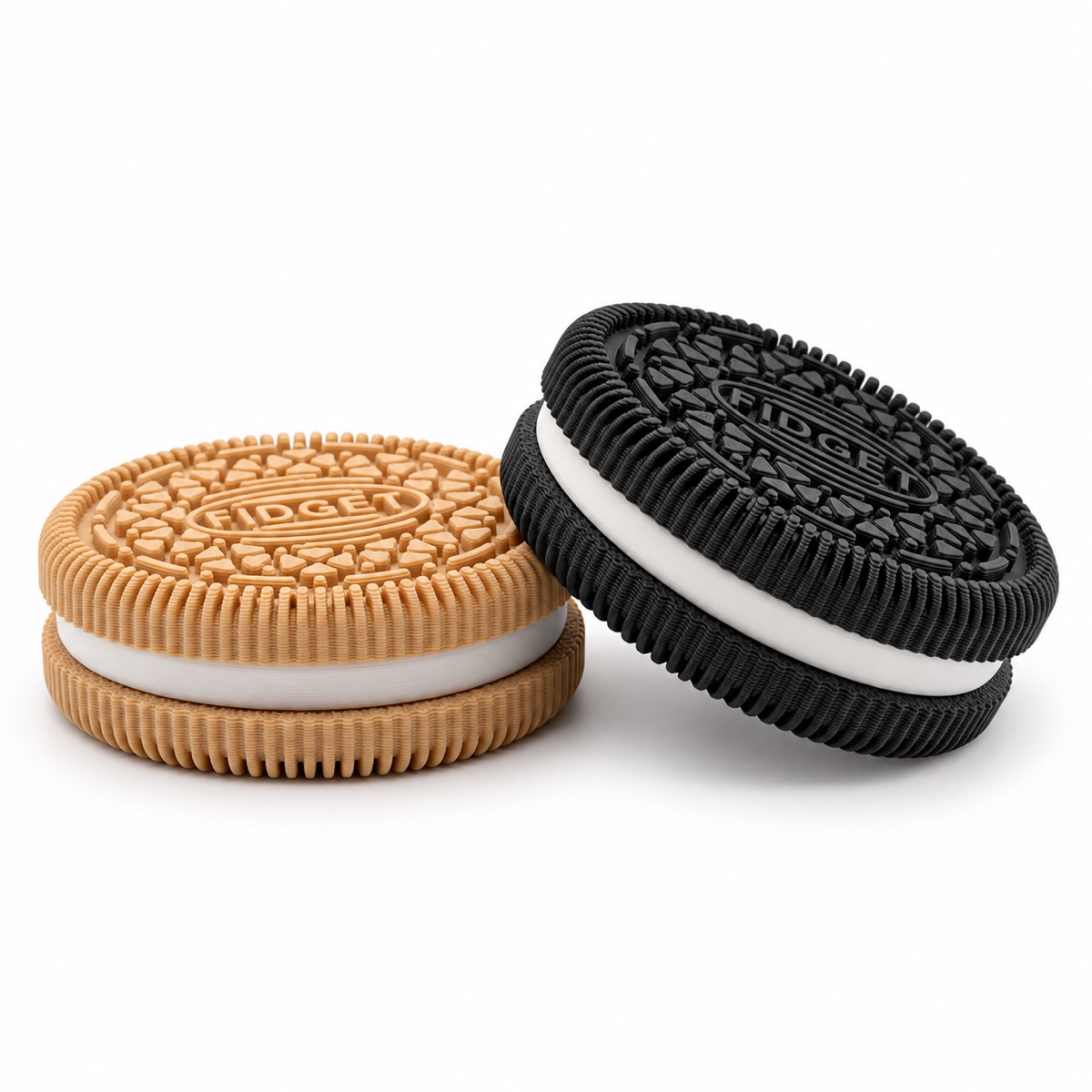
| Magnetic slider | Short back-and-forth or offset slide | Magnets and printed surfaces can make contact sounds | Italian Jelly Cookie or Sandwich Cookie |
| Spinner | Continuous circular rotation | Bearing and air movement create some sound | Chocolate Chip Cookie or S’mores |
| Clicker | Repeated press and release | Intentionally audible click | Macaron |
| Wiggle | Small articulated movement | Printed joints can make light contact sounds | Dumpling or Salmon Nigiri Wiggle |
Choose a magnetic slider if you like short, tactile movement
Sliders are about the transition between two positions. Push the top layer, feel the magnetic relationship change, then move it back. The compact motion can be satisfying for people who do not want the wide visual sweep of a spinner.
A slider also gives the food design a reveal: the “filling” or inner layer becomes more visible when the cookie opens. The tradeoff is that magnets require special care and are not suitable for every user or setting.
Choose a spinner if you enjoy continuous motion
A spinner turns one push into a longer rotation. You hold the center while the shaped outer body moves around it. That makes a spinner a good fit when you enjoy watching movement as well as feeling it.
The movement can be more visually noticeable to other people than a small slider action. Bearings and rotating bodies are also not silent, so “spinner” should not be treated as shorthand for “quiet classroom tool.”
Choose a clicker if the sound is part of the point
Clickers provide a clear press, actuation, and return. The response is immediate, repeatable, and deliberately audible. People who like keyboard switches often recognize the appeal quickly.
That same click can be unwelcome in class, meetings, shared offices, and quiet rooms. A clicker is a strong personal-desk or at-home choice, but it should be selected with the sound environment in mind.
Choose a Wiggle if you want a tiny character to collect
Wiggles are small articulated food characters rather than a single-purpose mechanical control. The appeal is split between gentle joint movement, a recognizable food shape, and the fun of building a collection.
They work naturally as desk buddies, shelf displays, small gifts, and themed sets. Their small scale also means adults should review size and parts before giving them to a child.